
There is a moment almost every home baker experiences without realising its significance. A cake comes out slightly undercooked in the centre or a batch of cupcakes sits out too long before frosting, and nothing feels wrong until later, a stomach upset, a complaint from a friend, an uneasy feeling that something was off. Most home bakers move past it quickly, chalking it up to bad luck. Few stop to ask whether it was actually a hygiene lapse. This gap between casual baking and professional baking becomes obvious the moment food safety enters the conversation and it is exactly why serious training through the best baking classes in Chennai spends so much time on something far less glamorous than frosting techniques or cake design.
This piece looks at why food safety and hygiene form the invisible backbone of a baker’s real competence, often more important than decoration skills in determining whether a baking career survives past its first year. It covers the basics that seem obvious but are frequently ignored, the science behind why certain hygiene rules exist rather than just following them blindly, the real-world consequences of cutting corners and how structured training environments build these habits until they become second nature rather than a checklist. It also addresses why many talented home bakers struggle when transitioning to commercial work, simply because hygiene discipline was never part of their learning. By the end, the goal is to shift how food safety is perceived, not as a bureaucratic requirement, but as the foundation that makes everything else in baking possible.
Why Does Hygiene Get Overlooked So Often?
Baking feels like a creative pursuit, so most attention naturally goes toward taste, texture, and appearance. Hygiene, by comparison, feels invisible when done correctly and only becomes noticeable when something goes wrong. This creates a false sense of security. A baker can get away with poor hygiene practices for months, sometimes years, before a single incident undoes their reputation entirely. The absence of visible consequences is often mistaken for safety when it is really just delayed risk.
What Does Proper Hygiene Actually Involve?
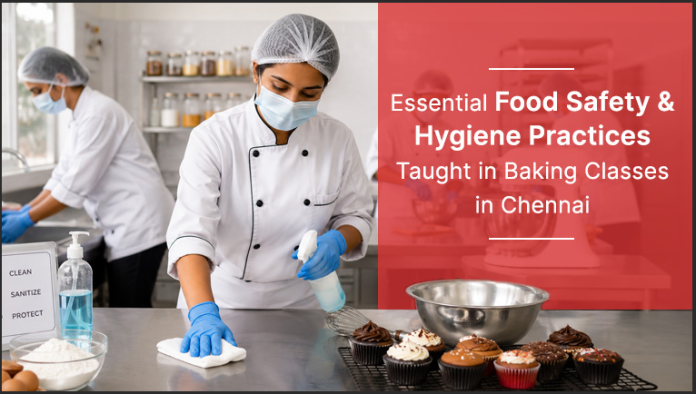
It starts long before flour touches a bowl. Clean workstations, sanitised equipment, washing hands properly before and during prep, keeping raw ingredients like eggs away from ready-to-eat components, these all sound like common sense. Yet they’re the first things that get skipped the moment time runs short. Temperature control matters just as much, keeping perishable fillings and creams within safe ranges, cooling baked goods properly before storage and understanding how quickly bacteria multiply in the wrong conditions. None of this is complicated once learned, but it requires consistency, not occasional effort.
Why Do These Rules Exist in the First Place?
Understanding the reasoning behind hygiene practices changes how seriously they get followed. Undercooked batters can harbour salmonella from raw eggs. Cross contamination between raw and cooked ingredients can transfer bacteria invisibly. Improper cooling allows moisture to build up, creating an environment where mould grows faster than most people realise. When bakers understand the biology behind these risks, hygiene stops feeling like an arbitrary rule and starts feeling like basic risk management, no different from wearing a seatbelt.
What Happens When These Practices Are Ignored?
The consequences rarely stay contained to a single customer. One case of food poisoning traced back to a bakery is all it takes to undo years of reputation built on good taste and consistency. Reviews spread faster than compliments ever did. Regulatory bodies can shut down operations, sometimes permanently, over repeated violations. Beyond the business impact, there is a simpler truth that gets lost in commercial conversations. People trust bakers with something deeply personal, their family’s health, their child’s birthday cake, their own body. That trust is fragile and difficult to rebuild once broken.
How Does Structured Training Build These Habits?
This is where the difference between casual baking and professional preparation becomes clear. Self taught bakers often learn hygiene practices reactively, after a mistake, if at all. Structured training environments build these habits proactively, embedding them into every session rather than treating them as a separate lesson. At Zeroin Academy, this approach shapes how practical sessions are conducted from the very beginning, hygiene is not an afterthought tacked onto the syllabus but a discipline woven into every hands-on class so that safe practices become instinctive rather than something students have to consciously remember under pressure.
Why Do Talented Home Bakers Struggle With This Transition?
Many skilled home bakers assume their years of experience automatically qualify them for commercial standards. It often does not. Home kitchens operate under far more forgiving conditions, smaller batches, shorter storage times, familiar ingredients used quickly. Commercial environments introduce variables home baking rarely tests, larger volumes, longer storage periods, multiple people handling the same ingredients, and stricter accountability. Bakers who skip formal training in this area often discover the gap only after a costly mistake, which is precisely why structured learning matters more than raw talent alone.
Is Hygiene Really as Important as Skill?
In many ways, more so. A beautifully decorated cake means nothing if it makes someone ill. Technical skill can be developed over time, refined through practice and feedback. Hygiene, on the other hand, has no room for gradual improvement, it either protects people or it does not. This is why serious baking education treats it as a non-negotiable foundation rather than an optional add-on, something to master before moving on to more advanced techniques.
That undercooked cake, that lingering unease after a batch of cupcakes sat out too long, is often the first quiet signal that hygiene deserves more attention than instinct alone provides. Recognising that signal early, rather than after something goes wrong, is what separates bakers who build lasting careers from those who learn the hard way. For those in Chennai looking to build that foundation properly, exploring baking classes Anna Nagar offers a starting point grounded not just in technique but in the discipline that keeps every technique safe to begin with. The oven forgives many mistakes. Hygiene rarely does.